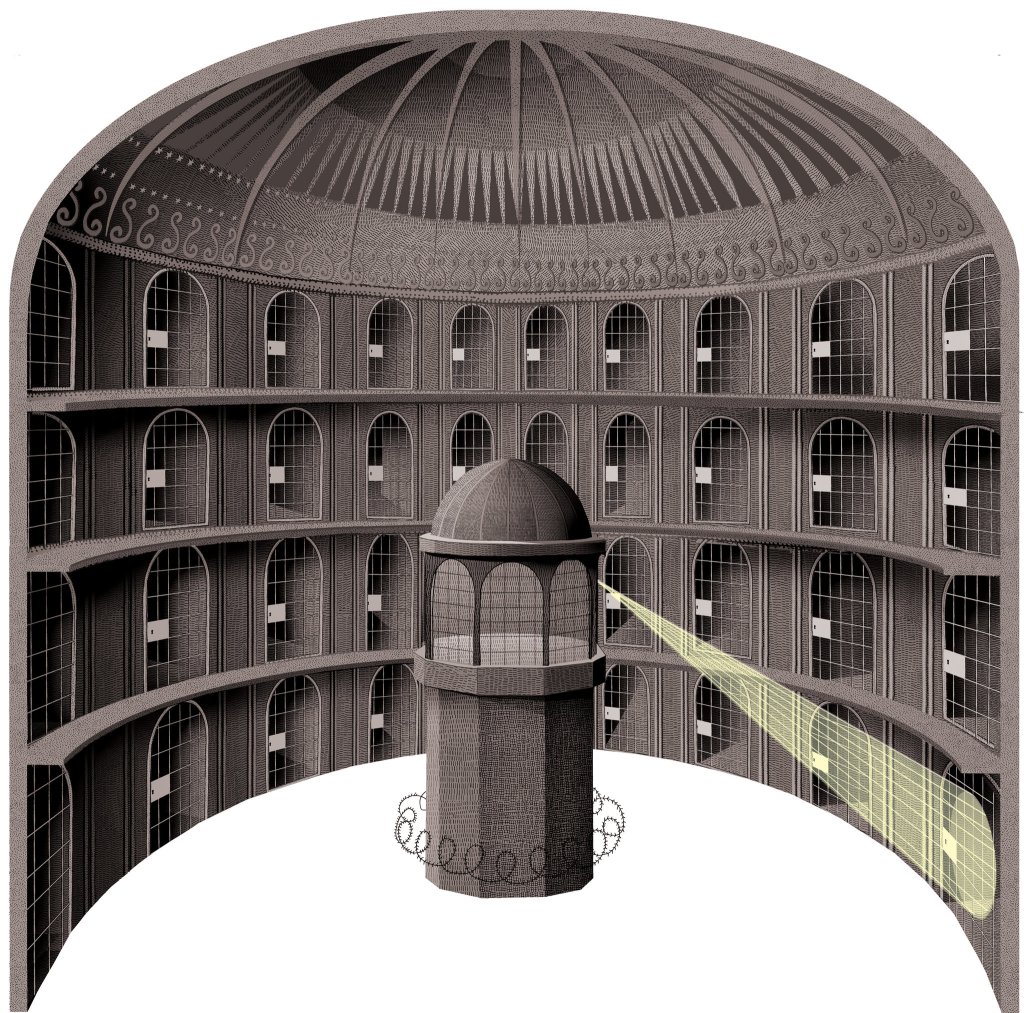
What is the Panopticon?
Designed as a circular prison that allows prisoners to be watched at all times without knowing when they are being seen, the panopticon was built to be the ‘perfect’ prison – though it was later argued that it caused the loss of privacy. Its design forces its inmates to act according to the rules at all times, because even if they might not actually be under surveillance by anyone, the fact that someone might be watching them eliminates any ideas to rebel.
Today, in our digital society, we can see how the internet is used for surveillance on users to keep them in check. Viewed as the central power in control, governments and intelligent organizations use their power to monitor the internet by gathering a colossal amount of data on its users and tracking their online actions. Just like the panopticon, digital surveillance is used to monitor users, by having the knowledge that their activities are tracked – whether it be by the government, corporations or a faceless entity through the applications they use. This pushes users to act according to the rules by adjusting their doings online to fit in to what is normal in fear of being scrutinized or getting in trouble; which is harmful in many ways.
Parallels between the panopticon, and the digital world
In the panopticon, the prisoners know that they are being watched, even if not all the time – on the internet, users aren’t always aware that they are being watched and that their data is being recorded. Because it is not happening physically and we cannot see a person watching us from our device, users might sometimes think they are anonymous. However, their data is being harvested by corporations which profit off of them. Besides, even if some argue that surveillance is utilized for good, such as protecting a certain individual or group, this means that another individual or group is controlled. This negatively impacts our society in many ways, leading to the loss of privacy. Which pushes users to rethink their actions, with the knowledge that their data is being collected, whether to build their algorithms, shape their opinions in ways that benefit those in power, to make money off of users or for governments to identify and seize up those against them. Sometimes users aren’t even aware that their data is being collected and distributed to other organizations, and this completely goes against a human’s rights to privacy.
How does Digital surviellance negatively affect our society?
Digital surveillance not only goes against the fundamentals of democracy and our privacy, but it also negatively affects our mental state by inducing anxiety, stress, and the fear of being watched from the privacy of our homes. The amount of data our devices have on us is so terrifyingly huge. And what’s scarier is that many people don’t even realize that when they accept ‘cookies’ on a website or the 10-page long privacy terms when activating an app, that they are blindly giving these corporations thousands of data points that will be later used against them. Digital surveillance opens the doors to the government and many organizations to use that data to promote better ads to get users to buy something the algorithms know they’ll like, or by promoting a video that aligns with the user’s political ideologies. Many people find this terrifying and nerve wracking, feeling like they are being closely watched by their devices, and that their decisions and opinions aren’t really theirs but are manufactured by algorithms. Which brings us back to the discussion that because users feel like they are being watched, out of fear they start to regulate their words and true opinions online which defeats the purpose of democracy on apps such as twitter which claims to be a free speech platform.
Ways in which digital surveillance can positively contribute to our society…
Disregarding the harms that arise from implementing digital surveillance in our society, it provides some benefits. Though digital surveillance makes many people feel like their privacy is being breached, it can also help with better security. For example, businesses can set-up CCTV systems to make the owners and workers feel safer in their workplace. By lowering the possibilities of robberies, work place abuse, and vandalism, as well as improving the productivity of employees. Digital surveillance can also be used to protect the public’s safety by monitoring street crimes like shootings, sexual assault, kidnappings and theft. It also impacts our globalized world too, not only regarding our breached privacy but also the increased hackings and cyber attacks in the economic world, the security of our country by using digital surveillance to predict threats through monitoring large data, and the ability for governments to monitor people abroad. However, the fact that implementing digital surveillance leads to more damage still stands. Because with all the positives that come with it, the negatives remain to outweigh its benefits as our privacy must be a human right.
Activists fighting against digital surveillance
Many activists have fought against digital surveillance and its consequences on users. For example, the Investigatory Powers Act, set in the UK was exposed to gathering personal data on the country’s citizens and having the right to hack into their phones. This puts activists in grave danger by the government and opposing parties through revealing personal information about them like their location. To help resist digital surveillance, activists use different communication platforms from those we know, such as Signal, Jitsi Meet and more, to better protect their privacy and data. For instance, David Carroll and several other activists have fought against Cambridge Analytica, a company that harvested millions of data on Facebook users without their knowledge in favor of the republican party in the 2016 elections and the EU decision. Carroll believes that a human’s privacy is a right, and data collected through their online actions must not be used for illegal ways to sway users decisions in such big matters. And this can only happen when we start fighting and resisting digital surveillance for using our data without our knowledge – new regulations must be implemented that protects our rights on the internet.

